SigLIP
SigLIP (Sigmoid Loss for Language-Image Pre-training) replaces the softmax-based contrastive objective used by CLIP and ALIGN with a simple pairwise sigmoid loss.
- Paper: Xiaohua Zhai, Basil Mustafa, Alexander Kolesnikov and Lucas Beyer (Google DeepMind, Zürich), Sigmoid Loss for Language Image Pre-Training, ICCV 2023, arXiv:2303.15343.
- Core idea: every image-text pair is treated as an independent binary classification problem (“is this pair matched or not?”) instead of requiring a batch-wide normalization.
- Properties: needs no global view of the batch’s pairwise similarity matrix, decouples the loss definition from the batch size, uses less memory, and outperforms the softmax loss at small-to-moderate batch sizes while matching it at large ones.
- Headline results: a SigLiT model reaches 79.7% zero-shot ImageNet accuracy training on just four TPU-v4 chips for one day; a from-scratch SigLIP model reaches 73.4% with 32 chips in five days.
- Used by: the vision encoder trained with this recipe (particularly the Shape-Optimized SoViT-400m variant) is what PaliGemma uses.
- Extended by: the loss and recipe are extended by SigLIP2.
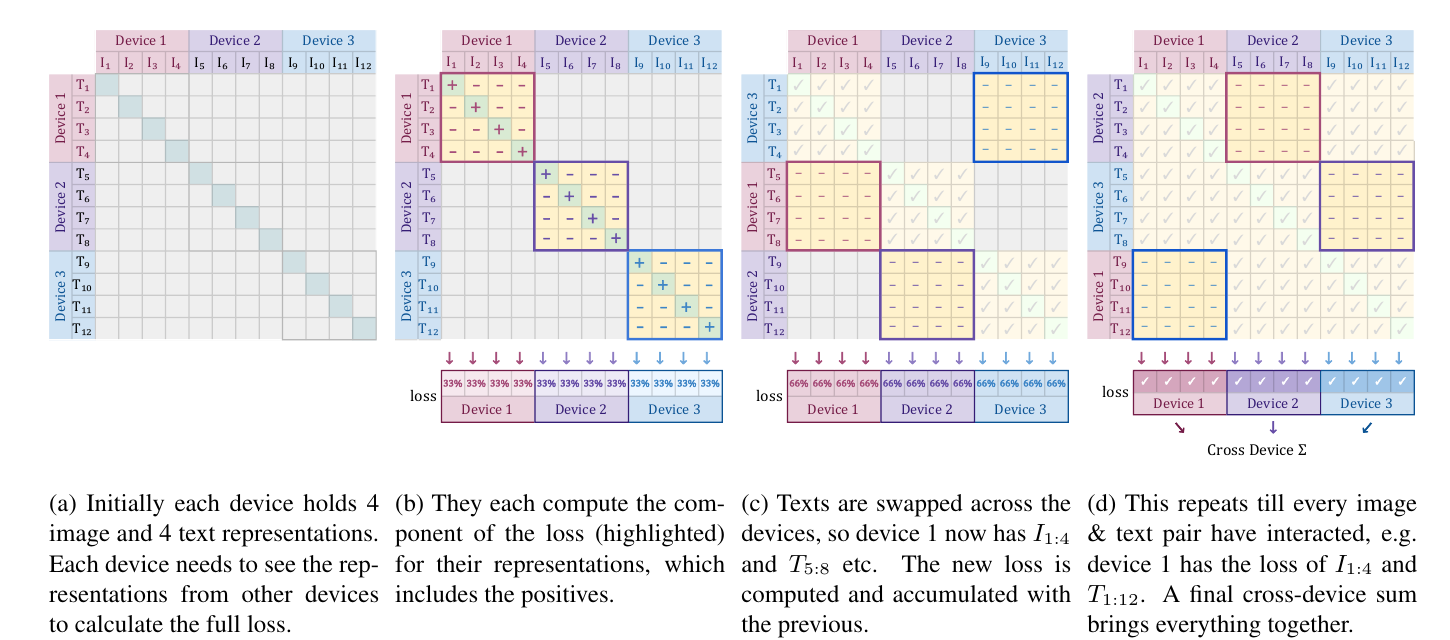
Fig. 1: efficient loss implementation. Three devices, global batch 12. Positives are computed locally (a,b), then negatives are gathered by permuting representations device-to-device (c,d) rather than performing an all-gather — only the highlighted tile is ever materialized.
Motivation: softmax normalization is a global, expensive dependency
Standard contrastive language-image pre-training (CLIP, ALIGN) aligns an image encoder and text encoder by pulling matched pairs together and pushing unmatched pairs apart, using a batch-level softmax loss applied twice — once normalizing over images for a fixed text, once over texts for a fixed image:
where , , and is a learnable temperature. Computing this exactly under data parallelism requires an all-gather of every embedding across devices and materializing a pairwise similarity matrix, which is both memory-hungry and numerically delicate — a naive softmax must be stabilized by first finding the row-wise maximum, which itself requires an extra pass over the full (gathered) batch. This global normalization is exactly what ties softmax-style contrastive learning to expensive infrastructure and very large batch sizes (CLIP: ~32k, BASIC/LAION-style studies pushing 16k–160k).
Sigmoid loss for language-image pre-training
SigLIP reformulates the problem as independent binary classification over all pair combinations in the batch — positive label for matched , negative for all :
where if are paired and otherwise. Since every term is now a fully local, independent computation, the loss requires no operation across the full batch — no all-gather, no global normalization, no numerically-sensitive max-subtraction — which is what makes it simpler to implement in a distributed setting and cheaper in memory.
A learnable bias term is added alongside the learnable temperature to counteract the severe class imbalance: for batch size there are positive pairs but negative ones (e.g. 268M negatives for only 16k positives at k), which at initialization would otherwise dominate the loss and force large, destabilizing early corrective gradient steps. and are initialized to and respectively so training starts close to the expected prior instead of requiring massive over-correction (Table 4 ablation: disabling , or initializing it to 0, both degrade downstream accuracy measurably).
# img_emb : image model embedding [n, dim]
# txt_emb : text model embedding [n, dim]
# t_prime, b : learnable temperature and bias
# n : mini-batch size
t = exp(t_prime)
zimg = l2_normalize(img_emb)
ztxt = l2_normalize(txt_emb)
logits = dot(zimg, ztxt.T) * t + b
labels = 2 * eye(n) - ones(n)   # -1 with diagonal 1
l = -sum(log_sigmoid(labels * logits)) / n
Efficient “chunked” implementation
Because the sigmoid loss decomposes into a sum of independent per-pair terms, a memory- and communication-efficient distributed implementation is possible that avoids materializing the full matrix at all. With per-device batch across devices, each device first computes the loss for its local positives and local negatives, then representations are permuted (not all-gathered) between neighboring devices one step at a time, accumulating the loss with respect to a fresh chunk of negatives on each step, until every image has interacted with every text after steps (Fig. 1). Peak memory is thus rather than , and the collective permutes are cheaper than the all-gathers a softmax-based loss requires. This chunked scheme is what enables training at batch sizes over one million on comparatively few accelerators.
Model naming: SigLiT vs. SigLIP
The paper studies the sigmoid loss in two settings that reuse CLIP’s naming convention: SigLiT applies it to Locked-image Tuning (LiT) — a frozen, pretrained image tower with only the text tower trained from scratch — and SigLIP applies it to standard from-scratch (or unlocked fine-tuning) contrastive pre-training of both towers, following the CLIP setup. Both use a ViT image encoder and a Transformer text encoder.
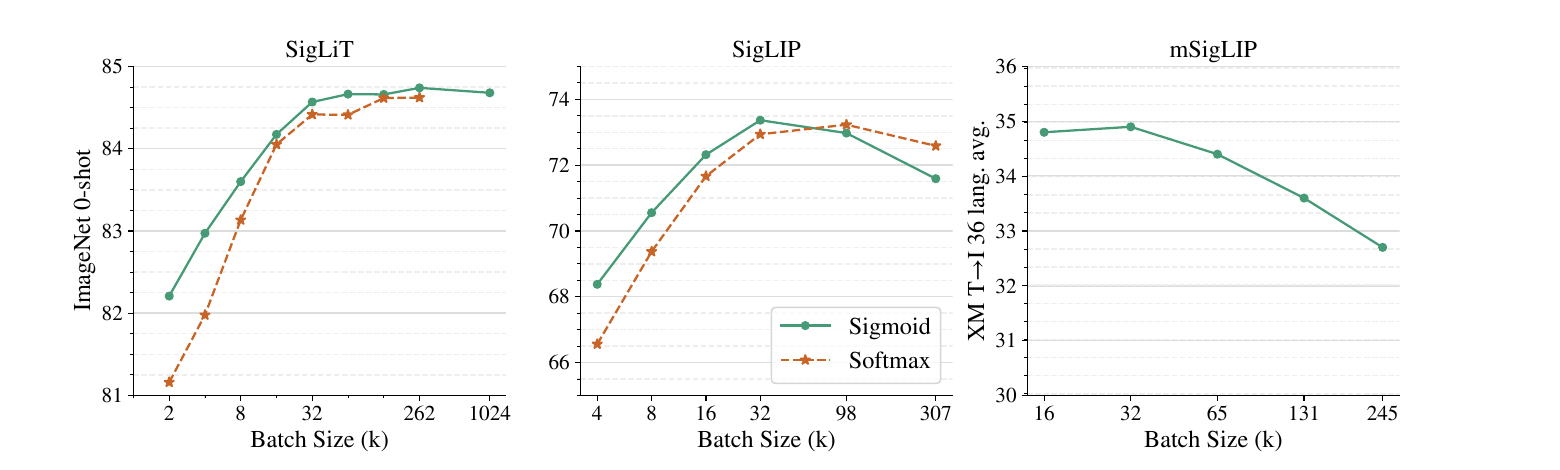
Fig. 2: sigmoid loss (green) beats softmax (orange) by a wide margin below 16k batch size and matches or slightly exceeds it beyond that. All three setups (SigLiT, SigLIP, multilingual mSigLIP) saturate around 32k batch size — scaling to one million (SigLiT) or 307k (SigLIP) gives at most a minor boost, and very large batches (e.g. 307k) can even hurt.
Architecture
- Image encoder: Vision Transformer (ViT), various sizes — B/16, B/8, L/16, g/14, So400m/14 (the Shape-Optimized 400M-parameter architecture from “Getting ViT in Shape”), evaluated at multiple input resolutions and patch counts (196–1024 patches).
- Text encoder: standard Transformer, sizes matched to the image tower (Base/Large/So400m-equivalent); a 32k-token English SentencePiece vocabulary trained on C4, sequences capped at 16 text tokens for the main SigLIP experiments (64 for the scaled-up runs). For multilingual mSigLIP, a larger 250k-token multilingual vocabulary is used with a bottlenecked token embedding ( embedding matrix plus a projection, ) to keep the embedding table small — costs only ~0.5% ImageNet zero-shot accuracy versus the full un-bottlenecked 250k vocabulary.
- Embeddings from both towers are L2-normalized before the dot product, scaled by the learned temperature , and offset by the learned bias .
- Optimizer: ScalingViT-Adafactor by default; the LION optimizer is used for the small-chip SigLiT/SigLIP experiments (Sections 4.4–4.5) for its memory efficiency.
Hyperparameters
Transcribed from Sections 4.1–4.6 and Table 1/3.
SigLiT (frozen image tower, four TPU-v4 chips)
| Image tower | frozen public ⚛B/8 checkpoint, or g/14 |
| Text tower | B-sized (12-layer variant of L), from scratch |
| Batch size | 32k (B/8) or 20k (g/14) |
| Training time | 1 day (B/8) or 2 days (g/14) |
| Result | 79.7% (B/8) / 84.5% (g/14) 0-shot ImageNet |
SigLIP from-scratch, small-chip regime (Section 4.4)
| Chips | 4 TPU-v4 |
| Image tower init | public unlocked ⚛B/16 (ViT-AugReg-B/16), precomputed embeddings |
| Text tower | Large Transformer but only 12 layers deep (instead of 24) |
| Optimizer | LION, decoupled weight decay |
| LR schedule | linear warm-up to peak over 6.5k steps, then cosine decay to 0 |
| Total steps | 65,000 |
| Batch size | 32k |
| Training time | just under 1 day |
| Result | 79.7% 0-shot ImageNet |
Key fine-tuning recipe fix: fine-tuning a locked/pretrained image tower degrades its representation quality unless weight decay is disabled specifically on the pre-trained image-tower weights (weight decay is kept only on the randomly-initialized text tower). This single change is what makes unlocked fine-tuning competitive; a 0.1 learning-rate multiplier is also applied to the pre-trained tower.
SigLIP main experiments (Section 4.2/4.6)
| Dataset | WebLI (English image-text pairs) |
| Image resolution | (main), (scaled-up, patches) |
| Text tokenizer | 32k-vocab SentencePiece (English C4) |
| Max text tokens | 16 (main), 64 (scaled-up) |
| Batch size | 32k (chosen as the near-optimal operating point across all sweeps) |
| Bias / temperature init | , (i.e. ) |
| Adam / AdaFactor | 0.95 (reduced from the default 0.999 to stabilize large-batch training) |
| Scaled-up training length | 40 billion examples seen |
| High-res fine-tune | 5 billion further examples, learning rate reduced , no weight decay |
mSigLIP (multilingual, Section 4.3/4.6)
| Dataset | WebLI, all 100 languages |
| Vocabulary | 250k-token multilingual SentencePiece, bottleneck , |
| Examples seen | 900M (vocabulary ablation) / 30B (main sweep) / scaled-up further in §4.6 |
| Batch size | 32k found sufficient; larger batches (up to 245k) do not help and can hurt XM3600 retrieval |
Results
Zero-shot ImageNet classification and MSCOCO retrieval, comparing publicly released models at matched configurations (Table 3):
| Method | ViT size | Patches | IN-1k val | IN-v2 | IN-ReaL | ObjectNet | COCO I→T | COCO T→I |
|---|---|---|---|---|---|---|---|---|
| CLIP | B | 196 | 68.3 | 61.9 | – | 55.3 | 52.4 | 33.1 |
| OpenCLIP | B | 196 | 70.2 | 62.3 | – | 56.0 | 59.4 | 42.3 |
| EVA-CLIP | B | 196 | 74.7 | 67.0 | – | 62.3 | 58.7 | 42.2 |
| SigLIP | B | 196 | 76.2 | 69.6 | 82.8 | 70.7 | 64.4 | 47.2 |
| SigLIP | B | 1024 | 79.2 | 73.0 | 84.9 | 74.7 | 67.6 | 50.4 |
| CLIP | L | 576 | 76.6 | 72.0 | – | 70.9 | 57.9 | 37.1 |
| EVA-CLIP | L | 576 | 80.4 | 73.8 | – | 78.4 | 64.1 | 47.9 |
| SigLIP | L | 576 | 82.1 | 75.9 | 87.0 | 81.0 | 70.6 | 52.7 |
| EVA-CLIP | E (5B params) | 729 | 82.0 | 75.7 | 87.5 | 79.6 | 68.8 | 51.1 |
| SigLIP | So (400M params) | 729 | 83.2 | 77.2 | 87.5 | 82.9 | 70.2 | 52.0 |
SigLIP-L beats all listed models including the much larger EVA-CLIP-E (5B parameters) and CLIPA-v2-H (630M), and the Shape-Optimized SigLIP-So400m matches or exceeds models several times its size — the headline claim that the sigmoid loss’s efficiency gains translate into a better accuracy/compute trade-off, not just cheaper training. The scaled-up multilingual mSigLIP ViT-B sets a new state of the art on XM3600 text→image retrieval at 34.9% recall@1, over 6 points above the prior LiT-based result (28.5%) that used a much larger 4B-parameter ViT-e.
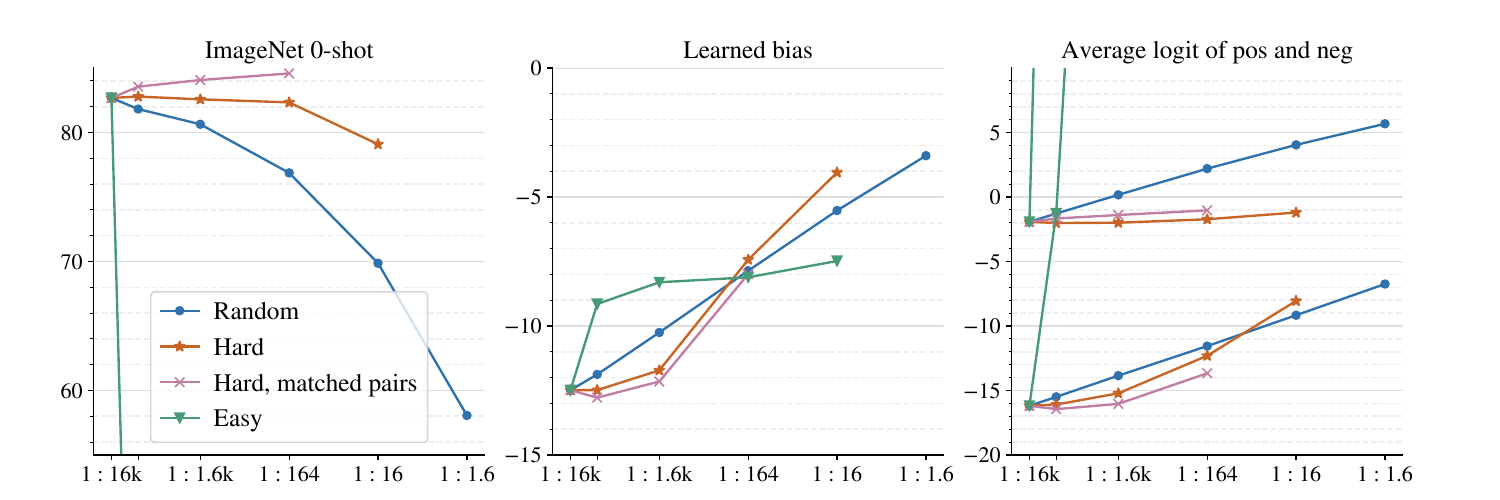
Fig. 6: keeping only the hardest negatives (orange) tracks the unmasked baseline (1:16k) almost exactly, while keeping only the easiest (green) collapses catastrophically — most of the useful learning signal comes from hard negatives, suggesting an efficient hard-negative-mining scheme is a promising (if nontrivial) direction.
Key ablations
- Batch size. Sigmoid loss dominates softmax below ~16k batch size, and the two are roughly on par above that; both saturate around 32k, and larger batches (up to the extreme of 1M for SigLiT) buy only minor further gains — a very large batch (e.g. 307k for SigLIP) can actively hurt.
- and stability. As batch size grows, training becomes increasingly unstable, seen as periodic spikes in the loss and gradient norm; reducing Adam/AdaFactor’s from 0.999 to 0.95 recovers from spikes faster and stabilizes large-batch training without removing the spikes entirely.
- Bias term. Disabling , or badly initializing it (0 instead of ), consistently hurts, especially when paired with a small initialization — the bias prevents large early over-correction from the positive/negative imbalance.
- Negative ratio / batch composition. Masking down to a near-balanced 1:1.6 positive:negative ratio by keeping only the hardest negatives preserves quality almost exactly; keeping only the easiest negatives collapses training. The imbalance itself is not the core issue — most useful gradient signal comes from hard negatives, and an efficient hard-negative-mining scheme is flagged as promising future work.
- Label / data-noise robustness. Under synthetic corruption of images, text, batch alignment, or combinations thereof, sigmoid-trained models retain a consistent accuracy edge over softmax-trained models as corruption probability increases (Fig. 7) — a property previously observed for sigmoid losses in supervised classification, now shown to transfer to contrastive image-text pre-training.
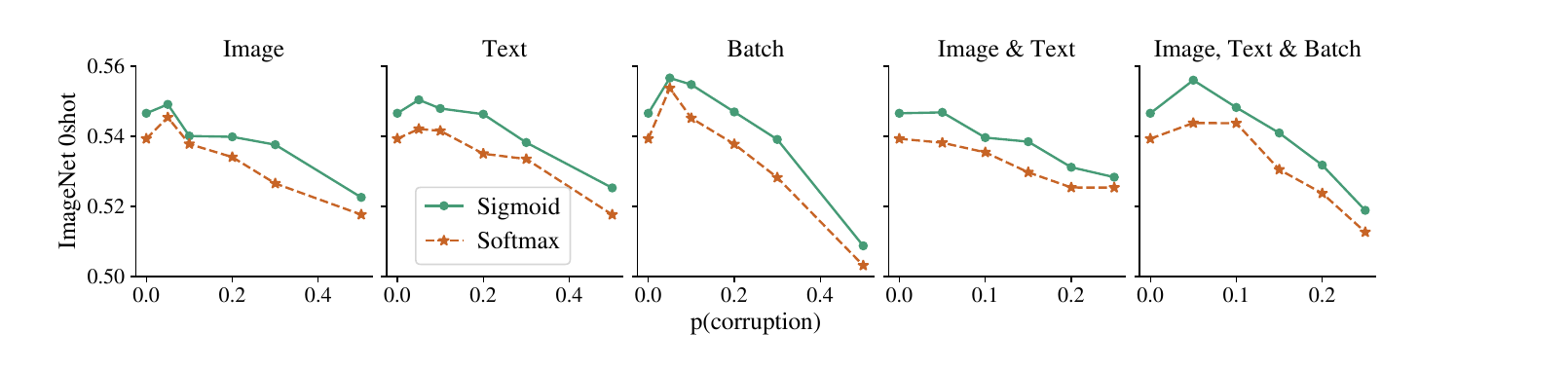
Fig. 7: sigmoid loss (green) stays above softmax (orange) across every corruption type and severity tested — noise robustness that plausibly matters given how noisy web-scraped image-text pairs are in practice.
Limitations
- Gains over softmax are concentrated at small-to-moderate batch sizes; at the large batch sizes historically used by the biggest contrastive pre-training runs (BASIC, LAION-style ≥64k), softmax quickly catches up and the two losses perform similarly.
- Very large batch sizes (100k+) can hurt both losses, and scaling beyond ~32k gives diminishing or even negative returns, undercutting the “just add more compute/larger batch” scaling intuition common in this literature.
- The paper deliberately does not propose an efficient hard-negative mining scheme, despite showing hard negatives carry most of the useful signal — this is left as future work.
- Fine-tuning a locked/pretrained image tower still requires the ad hoc fix of disabling weight decay specifically on those weights; the underlying reason fine-tuning otherwise degrades representation quality is not fully explained, only empirically worked around.
- Evaluation is zero-shot classification/retrieval and multilingual retrieval; the paper does not report dense-prediction transfer (detection/segmentation) of the resulting encoders, unlike some contemporaneous CLIP-family studies.
See also
- CLIP — the softmax-based contrastive baseline SigLIP directly compares against and inherits its architecture and naming conventions from
- SigLIP2 — follow-up work that builds directly on the sigmoid loss and SigLIP training recipe
- PaliGemma — a vision-language model that uses a SigLIP-trained vision encoder (So400m) as its image tower
- How to train your ViT — the ViT training/regularization recipe underlying the image towers used here
- Image Captioners Are Scalable Vision Learners Too — a generative alternative to contrastive image-text pre-training, evaluated in a similar setting
- TinyViT — a different angle on efficient ViT training, for small backbones rather than efficient contrastive losses